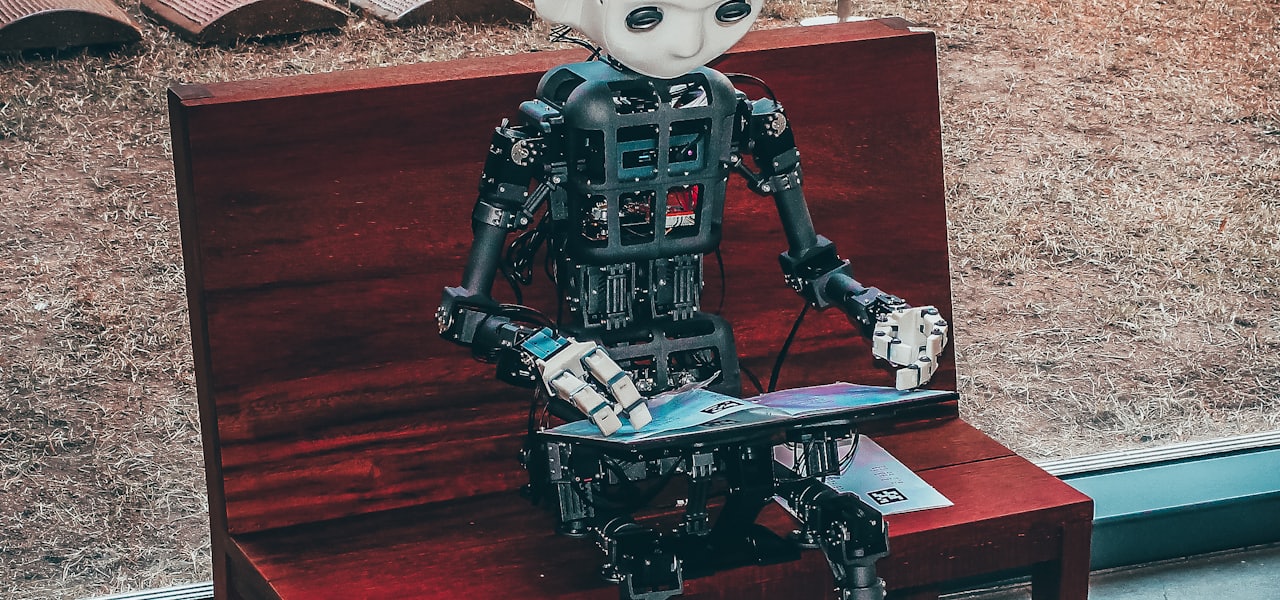
Automated negotiation is a form of interaction in systems that are composed of multiple autonomous agents, in which the aim is to reach agreements through an iterative process of making offers. Automated negotiation can be employed for many tasks human negotiators regularly engage in, such as bargaining and joint decision making. The main topics in automated negotiation revolve around the design of protocols and negotiating strategies. == History == Through digitization, the beginning of the 21st century has seen a growing interest in the automation of negotiation and e-negotiation systems, for example in the setting of e-commerce. This interest is fueled by the promise of automated agents being able to negotiate on behalf of human negotiators, and to find better outcomes than human negotiators. == Examples == Examples of automated negotiation include: Online dispute resolution, in which disagreements between parties are settled. Sponsored search auction, where bids are placed on advertisement keywords. Content negotiation, in which user agents negotiate over HTTP about how to best represent a web resource. Negotiation support systems, in which negotiation decision-making activities are supported by an information system.
Conference app
A conference app, also known as an event app or meeting app, is a mobile app developed to help attendees and meeting planners manage their conference experience. It typically includes conference proceedings and venue information, allowing users to create personalized schedules and engage with other users. A conference app can be a native app or web-based. In recent years, conference apps have gained in popularity as a sustainable solution for event management by reducing paper produced by printed materials. Advanced features often include real-time notifications for updates or changes, integration with virtual meeting platforms for hybrid or fully online events, and analytics tools for organizers to measure attendance and engagement. Additionally, some apps support sponsorship and exhibitor features, enabling businesses to showcase their products or services directly within the app.
Ho–Kashyap algorithm
The Ho–Kashyap algorithm is an iterative method in machine learning for finding a linear decision boundary that separates two linearly separable classes. It was developed by Yu-Chi Ho and Rangasami L. Kashyap in 1965, and usually presented as a problem in linear programming. == Setup == Given a training set consisting of samples from two classes, the Ho–Kashyap algorithm seeks to find a weight vector w {\displaystyle \mathbf {w} } and a margin vector b {\displaystyle \mathbf {b} } such that: Y w = b {\displaystyle \mathbf {Yw} =\mathbf {b} } where Y {\displaystyle \mathbf {Y} } is the augmented data matrix with samples from both classes (with appropriate sign conventions, e.g., samples from class 2 are negated), w {\displaystyle \mathbf {w} } is the weight vector to be determined, and b {\displaystyle \mathbf {b} } is a positive margin vector. The algorithm minimizes the criterion function: J ( w , b ) = | | Y w − b | | 2 {\displaystyle J(\mathbf {w} ,\mathbf {b} )=||\mathbf {Yw} -\mathbf {b} ||^{2}} subject to the constraint that b > 0 {\displaystyle \mathbf {b} >\mathbf {0} } (element-wise). Given a problem of linearly separating two classes, we consider a dataset of elements { ( x i , y i ) } i ∈ 1 : N {\displaystyle \{(\mathbf {x_{i}} ,y_{i})\}_{i\in 1:N}} where y i ∈ { − 1 , + 1 } {\displaystyle y_{i}\in \{-1,+1\}} . Linearly separating them by a perceptron is equivalent to finding weight and bias w , b {\displaystyle \mathbf {w} ,b} for a perceptron, such that: [ y 1 x 1 1 ⋮ ⋮ y N x N 1 ] [ w b ] > 0 {\displaystyle {\begin{bmatrix}y_{1}\mathbf {x} _{1}&1\\\vdots &\vdots \\y_{N}\mathbf {x} _{N}&1\\\end{bmatrix}}{\begin{bmatrix}\mathbf {w} \\b\end{bmatrix}}>0} == Algorithm == The idea of the Ho–Kashyap algorithm is as follows: Given any b {\displaystyle \mathbf {b} } , the corresponding w {\displaystyle \mathbf {w} } is known: It is simply w = Y + b {\displaystyle \mathbf {w} =\mathbf {Y} ^{+}\mathbf {b} } , where Y + {\displaystyle \mathbf {Y} ^{+}} denotes the Moore–Penrose pseudoinverse of Y {\displaystyle \mathbf {Y} } . Therefore, it only remains to find b {\displaystyle \mathbf {b} } by gradient descent. However, the gradient descent may sometimes decrease some of the coordinates of b {\displaystyle \mathbf {b} } , which may cause some coordinates of b {\displaystyle \mathbf {b} } to become negative, which is undesirable. Therefore, whenever some coordinates of b {\displaystyle \mathbf {b} } would have decreased, those coordinates are unchanged instead. As for the coordinates of b {\displaystyle \mathbf {b} } that would increase, those would increase without issue. Formally, the algorithm is as follows: Initialization: Set b ( 0 ) {\displaystyle \mathbf {b} (0)} to an arbitrary positive vector, typically b ( 0 ) = 1 {\displaystyle \mathbf {b} (0)=\mathbf {1} } (a vector of ones). Set the iteration counter k = 0 {\displaystyle k=0} . Set w ( 0 ) = Y + b ( 0 ) {\displaystyle \mathbf {w} (0)=\mathbf {Y} ^{+}\mathbf {b} (0)} Loop until convergence, or until iteration counter exceeds some k m a x {\displaystyle k_{max}} . Error calculation: Compute the error vector: e ( k ) = Y w ( k ) − b ( k ) {\displaystyle \mathbf {e} (k)=\mathbf {Yw} (k)-\mathbf {b} (k)} . Margin update: Update the margin vector: b ( k + 1 ) = b ( k ) + 2 η k ( e ( k ) + | e ( k ) | ) {\displaystyle \mathbf {b} (k+1)=\mathbf {b} (k)+2\eta _{k}(\mathbf {e} (k)+|\mathbf {e} (k)|)} where η k {\displaystyle \eta _{k}} is a positive learning rate parameter, and | e ( k ) | {\displaystyle |\mathbf {e} (k)|} denotes the element-wise absolute value. Weight calculation: Compute the weight vector using the pseudoinverse: w ( k + 1 ) = Y + b ( k + 1 ) {\displaystyle \mathbf {w} (k+1)=\mathbf {Y} ^{+}\mathbf {b} (k+1)} . Convergence check: If | | e ( k ) | | ≤ θ {\displaystyle ||\mathbf {e} (k)||\leq \theta } for some predetermined threshold θ {\displaystyle \theta } (close to zero), then return b ( k + 1 ) , w ( k + 1 ) {\displaystyle \mathbf {b} (k+1),\mathbf {w} (k+1)} . if e ( k ) ≤ 0 {\displaystyle \mathbf {e} (k)\leq \mathbf {0} } (all components non-positive), return "Samples not separable.". Return "Algorithm failed to converge in time.". == Properties == If the training data is linearly separable, the algorithm converges to a solution (where e ( k ) = 0 {\displaystyle \mathbf {e} (k)=\mathbf {0} } ) in a finite number of iterations. If the data is not linearly separable, the algorithm may or may not ever reach the point where e ( k ) = 0 {\displaystyle \mathbf {e} (k)=\mathbf {0} } . However, if it does happen that e ( k ) ≤ 0 {\displaystyle \mathbf {e} (k)\leq \mathbf {0} } at some iteration, this proves non-separability. The convergence rate depends on the choice of the learning rate parameter ρ {\displaystyle \rho } and the degree of linear separability of the data. == Relationship to other algorithms == Perceptron algorithm: Both seek linear separators. The perceptron updates weights incrementally based on individual misclassified samples, while Ho–Kashyap is a batch method that processes all samples to compute the pseudoinverse and updates based on an overall error vector. Linear discriminant analysis (LDA): LDA assumes underlying Gaussian distributions with equal covariances for the classes and derives the decision boundary from these statistical assumptions. Ho–Kashyap makes no explicit distributional assumptions and instead tries to solve a system of linear inequalities directly. Support vector machines (SVM): For linearly separable data, SVMs aim to find the maximum-margin hyperplane. The Ho–Kashyap algorithm finds a separating hyperplane but not necessarily the one with the maximum margin. If the data is not separable, soft-margin SVMs allow for some misclassifications by optimizing a trade-off between margin size and misclassification penalty, while Ho–Kashyap provides a least-squares solution. == Variants == Modified Ho–Kashyap algorithm changes weight calculation step w ( k + 1 ) = Y + b ( k + 1 ) {\displaystyle \mathbf {w} (k+1)=\mathbf {Y} ^{+}\mathbf {b} (k+1)} to w ( k + 1 ) = w ( k ) + η k Y + | e ( k ) | {\displaystyle \mathbf {w} (k+1)=\mathbf {w} (k)+\eta _{k}\mathbf {Y} ^{+}|\mathbf {e} (k)|} . Kernel Ho–Kashyap algorithm: Applies kernel methods (the "kernel trick") to the Ho–Kashyap framework to enable non-linear classification by implicitly mapping data to a higher-dimensional feature space.
Pruning (artificial neural network)
In deep learning, pruning is the practice of removing parameters from an existing artificial neural network. The goal of this process is to reduce the size (parameter count) of the neural network (and therefore the computational resources required to run it) whilst maintaining accuracy. This can be compared to the biological process of synaptic pruning which takes place in mammalian brains during development. == Node (neuron) pruning == A basic algorithm for pruning is as follows: Evaluate the importance of each neuron. Rank the neurons according to their importance (assuming there is a clearly defined measure for "importance"). Remove the least important neuron. Check a termination condition (to be determined by the user) to see whether to continue pruning. == Edge (weight) pruning == Most work on neural network pruning does not remove full neurons or layers (structured pruning). Instead, it focuses on removing the most insignificant weights (unstructured pruning), namely, setting their values to zero. This can either be done globally by comparing weights from all layers in the network or locally by comparing weights in each layer separately. Different metrics can be used to measure the importance of each weight. Weight magnitude as well as combinations of weight and gradient information are commonly used metrics. Early work suggested also to change the values of non-pruned weights. == When to prune the neural network? == Pruning can be applied at three different stages: before training, during training, or after training. When pruning is performed during or after training, additional fine-tuning epochs are typically required. Each approach involves different trade-offs between accuracy and computational cost.
Oscillatory neural network
An oscillatory neural network (ONN) is an artificial neural network that uses coupled oscillators as neurons. Oscillatory neural networks are closely linked to the Kuramoto model, and are inspired by the phenomenon of neural oscillations in the brain. Oscillatory neural networks have been trained to recognize images. Complex-Valued Oscillatory network has also been shown to store and retrieve multidimensional aperiodic signals. An oscillatory autoencoder has also been demonstrated, which uses a combination of oscillators and rate-coded neurons. A neuron made of two coupled oscillators, one having a fixed and the other having a tunable natural frequency, has been shown able to run logic gates such as XOR that conventional sigmoid neurons cannot.
Semantic interpretation
Semantic interpretation is an important component in dialog systems. It is related to natural language understanding, but mostly it refers to the last stage of understanding. The goal of interpretation is binding the user utterance to concept, or something the system can understand. Typically it is creating a database query based on user utterance.
Canonical correspondence analysis
In multivariate analysis, canonical correspondence analysis (CCA) is an ordination technique that determines axes from the response data as a unimodal combination of measured predictors. CCA is commonly used in ecology in order to extract gradients that drive the composition of ecological communities. CCA extends correspondence analysis (CA) with regression, in order to incorporate predictor variables. == History == CCA was developed in 1986 by Cajo ter Braak and implemented in the program CANOCO, an extension of DECORANA. To date, CCA is one of the most popular multivariate methods in ecology, despite the availability of contemporary alternatives. CCA was originally derived and implemented using an algorithm of weighted averaging, though Legendre & Legendre (1998) derived an alternative algorithm. == Assumptions == The requirements of a CCA are that the samples are random and independent. Also, the data are categorical and that the independent variables are consistent within the sample site and error-free. The original publication states the need for equal species tolerances, equal species maxima, and equispaced or uniformly distributed species optima and site scores.